7 Bathroom Design Mistakes That Cost You Thousands (And How to Fix Them)
Bathrooms are deceptively expensive rooms to get wrong.
They're small, so people assume they're simple. But square foot for square foot, bathrooms cost more to renovate than almost any other room in your home. Between plumbing, waterproofing, tile work, fixtures, and ventilation, a typical bathroom remodel runs $10,000–$30,000. And when mistakes happen? You're either living with regret or paying to fix them.
The good news: most bathroom design mistakes are entirely preventable. Here are the seven most common ones we see — and exactly how to avoid them.
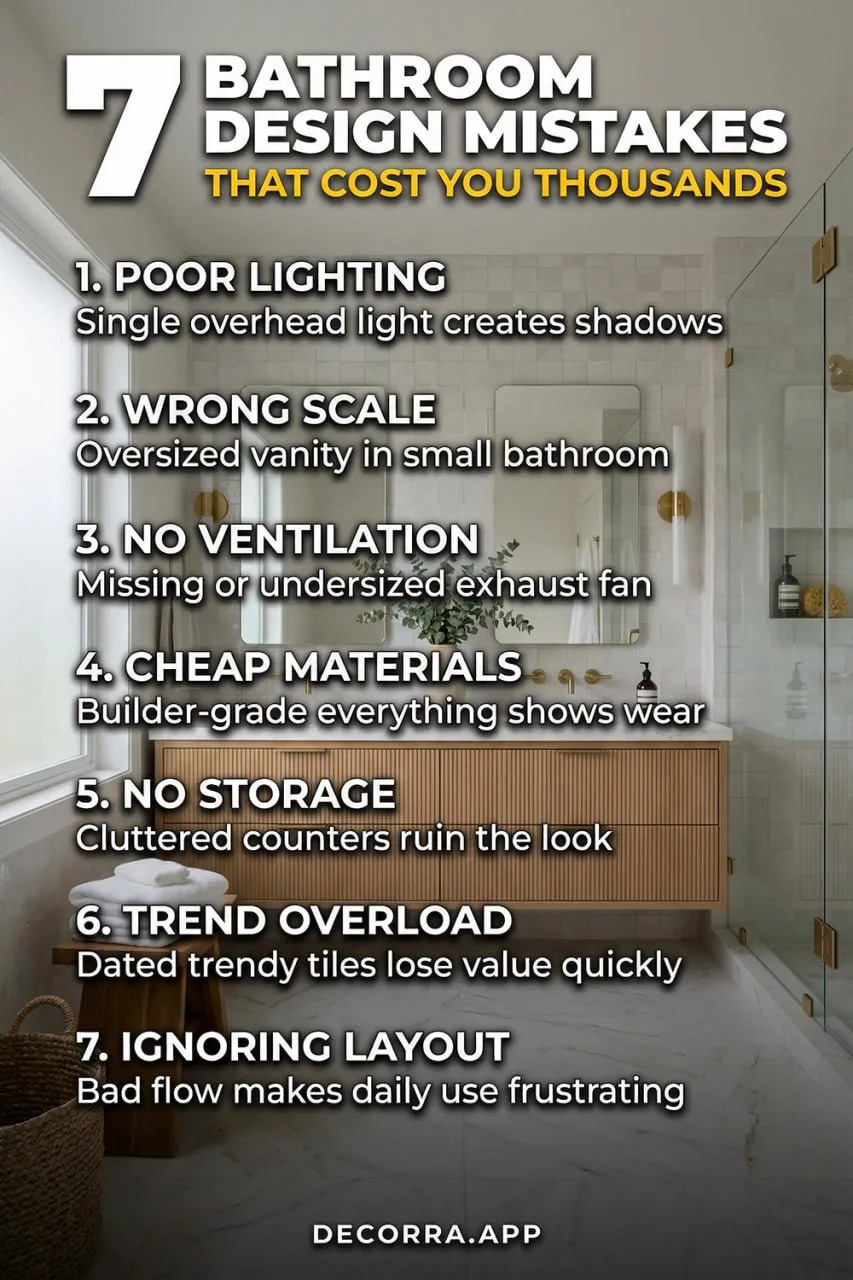
1. Poor Lighting (The #1 Offender)
If your bathroom has a single overhead light — congratulations, you have the most common bathroom design mistake in existence.
Why it's a problem: A single ceiling fixture creates harsh shadows, especially on your face. Ever wonder why you look great in natural light but like a horror movie extra in your bathroom mirror? That's bad lighting.
What it costs you: Aside from daily frustration, poor lighting makes your entire bathroom feel smaller, cheaper, and less inviting — dragging down the perceived value of your home.
The fix: Layer your bathroom lighting with three types:
- Task lighting — Sconces flanking the mirror at face height (not above it). This eliminates shadows and gives you even, flattering light for grooming.
- Ambient lighting — A flush-mount ceiling fixture or recessed lights for general illumination.
- Accent lighting — LED strips under a floating vanity or behind a mirror create depth and a spa-like atmosphere.
Dimmer switches on everything. Non-negotiable. A bathroom that's bright at 7 AM and moody at 10 PM is a bathroom that works.
2. Wrong Scale Fixtures and Furniture
That gorgeous double vanity you fell in love with on Instagram? It might be 72 inches wide. Your bathroom might be 60 inches wide. This happens more than you'd think.
Why it's a problem: Oversized fixtures make a bathroom feel cramped and awkward. Undersized ones make it feel like an afterthought. Either way, the proportions feel off, and you can't quite put your finger on why.
What it costs you: Returning or replacing fixtures isn't cheap — and if plumbing has already been roughed in for the wrong size, you're looking at additional labor costs.
The fix: Measure everything. Then measure again. Leave a minimum of 15 inches from the center of the toilet to any side wall or fixture. Ensure at least 21 inches of clearance in front of the toilet and vanity (30 inches is better). For vanities, go as large as the space comfortably allows — but "comfortably" means you can still move freely.
Pro tip: Use painter's tape to outline fixture dimensions on the floor and walls before purchasing. Live with the tape for a few days. You'll quickly see if something is too big or too small.
3. Ignoring Ventilation
This is the boring mistake that costs the most money long-term.
Why it's a problem: Moisture is a bathroom's worst enemy. Without proper ventilation, you're inviting mold, mildew, peeling paint, warped wood, and eventually structural damage. That "musty bathroom smell" isn't character — it's decay.
What it costs you: Mold remediation averages $1,500–$3,500. Replacing water-damaged drywall and subfloor? Even more. And once mold gets into wall cavities, it becomes a health issue.
The fix: Install an exhaust fan rated for your bathroom's square footage (minimum 1 CFM per square foot). For a 50-square-foot bathroom, you need at least a 50 CFM fan.
Run it during every shower and for 20 minutes after. Better yet, install a humidity-sensing fan that turns on and off automatically. They cost slightly more upfront but they actually get used — unlike the manual switch everyone forgets.
4. Choosing Cheap Materials in a Wet Environment
We get it. Budgets are real. But the bathroom is the absolute worst place to cut corners on materials.
Why it's a problem: Bathrooms endure daily exposure to water, humidity, temperature swings, and cleaning chemicals. Materials that work fine in a bedroom or kitchen will fail spectacularly in a bathroom. Laminate countertops swell. MDF vanities warp. Cheap grout cracks and stains.
What it costs you: Replacing a disintegrating vanity after two years costs more than buying a quality one upfront. Water damage from failed materials can cascade into far more expensive repairs.
The fix:
- Countertops: Quartz, granite, or solid surface. Skip laminate.
- Vanity cabinet: Solid wood or marine-grade plywood. Never MDF in a wet environment.
- Tile: Porcelain over ceramic for floors (lower water absorption rate). Ensure proper waterproofing membrane behind shower tile.
- Grout: Epoxy grout in wet areas. It's harder to apply but virtually waterproof and stain-proof.
- Hardware: Solid brass or stainless steel. Cheap zinc alloy corrodes fast in humid environments.
Spend more on what gets wet. Save on what doesn't.
5. Neglecting Storage
A bathroom without adequate storage is a bathroom with products lined up along the tub edge, crowding the countertop, and balanced precariously on the toilet tank. We've all been there.
Why it's a problem: Clutter makes even a beautifully designed bathroom feel chaotic. And the workarounds — freestanding shelves, over-the-toilet units, shower caddies — usually look cheap and take up floor space you can't afford to lose.
What it costs you: Retrofitting storage into a finished bathroom is awkward and expensive. Recessing a medicine cabinet into a finished wall? That's opening up drywall. Adding built-in niches to an already-tiled shower? Not happening without a tear-out.
The fix: Plan storage from the start:
- Recessed medicine cabinet — Built into the wall, it provides storage without taking up space
- Vanity with drawers — Drawers beat doors for accessibility and organization
- Built-in shower niches — Planned during the tile phase, they're seamless and functional
- Towel hooks over bars — Hooks use less wall space and people actually use them
The goal: everything has a home, and that home is behind a door or inside a drawer.
6. Trend Overload
That all-pink bathroom looked amazing on TikTok in 2024. Will it look amazing in 2030? History suggests… probably not.
Why it's a problem: Bathrooms are expensive to renovate and you live with them for 10–20 years. Going all-in on a trend means you're either stuck with it long after it peaks or paying to redo it.
What it costs you: A full bathroom re-tile runs $1,500–$5,000+ depending on size. Replacing a colored toilet or tub because the color dated? That's plumbing work on top of fixture costs.
The fix: Use the "bones and accessories" rule:
- Bones (keep neutral): Tile, countertops, toilet, tub/shower, vanity cabinet. These are expensive to replace. Keep them in timeless neutrals — white, warm gray, natural stone tones.
- Accessories (go trendy): Paint color, hardware, mirrors, light fixtures, towels, art. These are cheap and easy to swap when your taste evolves.
You can absolutely have a trendy bathroom. Just make sure the trendy parts are the ones you can change in an afternoon, not the ones that require a contractor.
7. Ignoring the Layout
This is the mistake that's hardest to fix after the fact — because it's literally built into the walls.
Why it's a problem: A bad layout means awkward traffic flow, doors that hit fixtures, wasted space, and daily frustration. The toilet shouldn't be the first thing you see when the door opens. The shower shouldn't be so far from the towel hook that you drip across the floor every morning.
What it costs you: Moving plumbing is the most expensive change in a bathroom renovation — $1,000–$5,000+ per fixture. If you get the layout wrong, you're either living with it or spending big to move pipes.
The fix: Before committing to any layout:
- Prioritize the sight line from the door. What do you see first? Make it the vanity or a beautiful tile wall — not the toilet.
- Keep wet fixtures together — toilet, shower, and tub on the same wall or adjacent walls simplifies plumbing and reduces costs.
- Ensure door clearance — the door should open fully without hitting the vanity or toilet.
- Think about daily flow — where do you step out of the shower? Where do you reach for a towel? Walk through your morning routine mentally before finalizing the plan.
Visualize Before You Commit
The best way to avoid expensive bathroom mistakes? See your design before you build it.
With Decorra, you can snap a photo of your current bathroom and instantly visualize it in different styles, layouts, and color schemes using AI. Test ideas, compare options, and catch potential mistakes — all before spending a single dollar on demolition.
It's like having a design consultant in your pocket.
👉 Try Decorra free and redesign your bathroom today
Your bathroom is too expensive to guess. See it first. Decide second. Renovate with confidence.